Craft notes · 7 September 2026 · 3 min read
Cladding that stays flat
Why big metal panels sometimes look wavy, and the three things in the making that stop it.
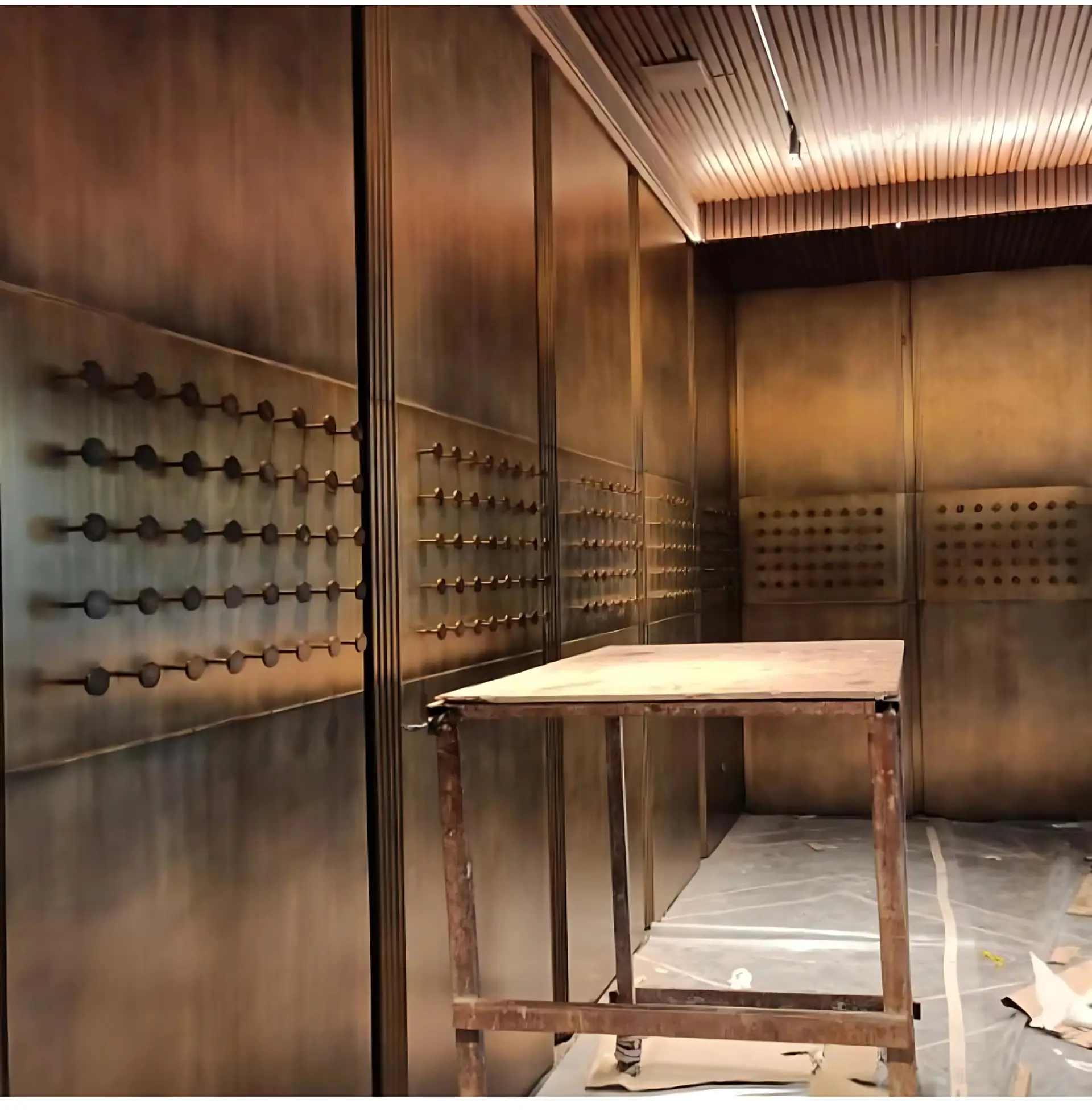
Sheet metal is never perfectly flat, and a big unbroken face shows every ripple the moment light runs along it. A wavy wall is almost never the fault of the metal. It is a panel that was too large for its thickness, or fixed to a frame that was not straight, or made without the edge that would have held it true.
The sub-frame
Cladding is only as flat as what it hangs on. The sub-frame is set out and levelled first, checked with a laser, and the panels go onto that. Trying to flatten a wall by adjusting the visible panels never works; the eye reads the line of the joints, and that line comes from the frame.
Panel size
Every metal and thickness has a size beyond which a panel will not stay flat on its own. Beyond it, the panel is either made thicker, backed with a stiffener, or divided — and a joint placed on purpose reads far better than a ripple that arrived by accident. The panel layout is a drawing, not a consequence.
The return
A folded edge — the return — is what gives a thin sheet its stiffness. A panel with a return on every side is a shallow tray, and a tray stays flat where a flat sheet will not. The return is also what lets a panel hang on a concealed clip, so that it can be lifted off individually to reach services behind and go back in the same place.
Movement
Metal expands in the afternoon and shrinks at night. Panels are sized so that movement stays small, fixed at one point and allowed to slide at the others, and joints are designed to open and close by a planned amount. Indoors this is a few millimetres; outdoors, on a facade in the sun, it is what decides whether the wall survives its first summer.